Aug 05, 2026/Result/Mathematics
An alternative proof of the Ehrhart volume conjecture from a less powerful model
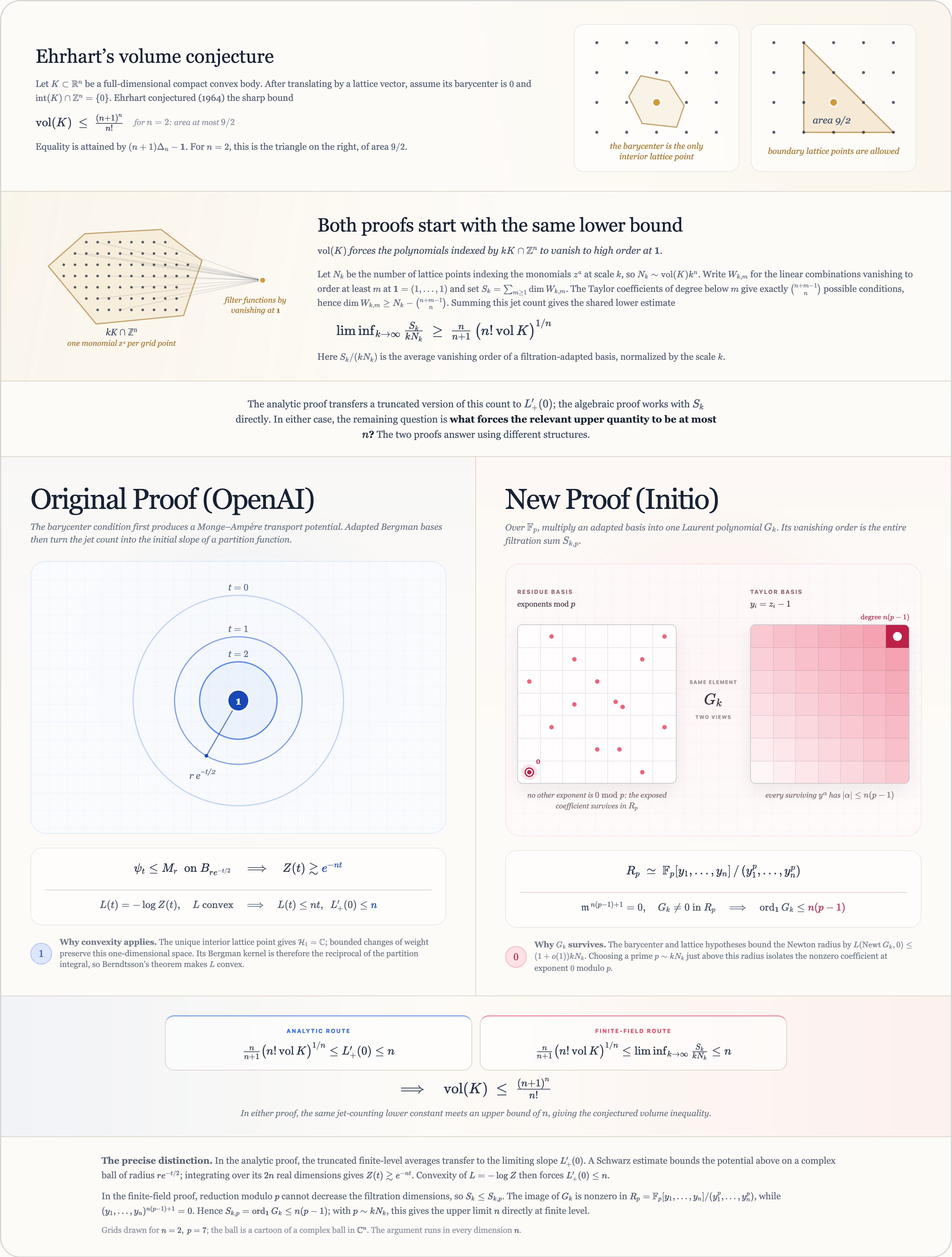
We are sharing a new and autonomously generated proof of the Ehrhart Volume Conjecture. A proof of this conjecture was released by OpenAI on August 1 to demonstrate the capabilities of Astra, a powerful new model that currently is only available internally at OpenAI. Initio was able to independently produce an alternative proof for this same conjecture using an older model.
This demonstrates that with the right approach, it is possible to extract better performance from weaker models even for unsolved, open-ended problems. By understanding how to push models to their fullest potential, we can accelerate development and achieve work with higher impact.
This work was produced independently and resulted in a different proof: while OpenAI’s arguments rely on ideas from complex geometry, our new proof is more algebraic. A PDF detailing our proof along with a comparison of both approaches is shared at the end of this post.
Importantly, the system we used to generate this proof had no knowledge of the result by OpenAI. It had no web access, and the underlying model we utilized inside the harness was 5.6-Sol, which was trained prior to the release of this proof. No hints or suggestions were given to the system. We can share traces verifying that no web search was used and additional information to researchers and partners upon request.
Our work points towards capabilities being unlocked by the systems built around models. It also highlights the importance of test-time compute and the systems built to control long-horizon research. As models become more capable, it becomes harder to push them to their limits, and optimizing test-time compute becomes increasingly important in extracting value and directing them towards productive discovery.